
Training · August 5, 2026 · 5 min read
"Do Not Pet": What a Service Dog In Training Vest Really Means
That black vest with the white lettering is a working uniform. Here's what a dog in training is actually learning, why petting interrupts it, and how the public can help.
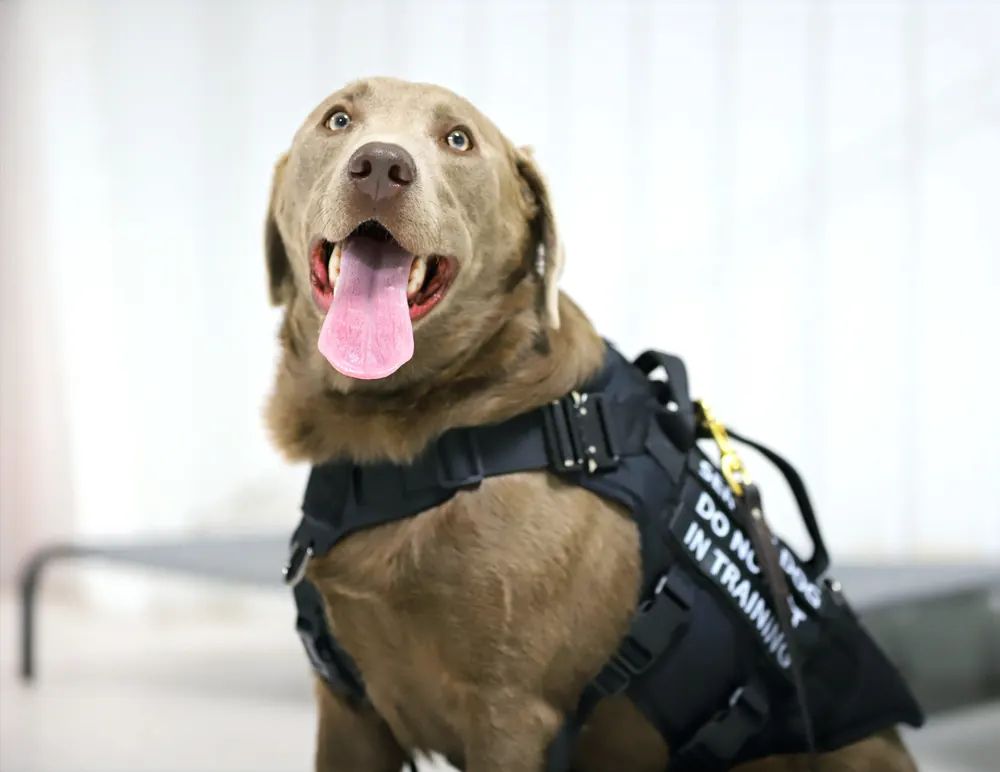
You have probably seen it in a grocery aisle or a waiting room: a calm dog in a black harness, patches reading SERVICE DOG IN TRAINING and DO NOT PET. It is one of the most misunderstood pieces of equipment in public life. The vest is not decoration and it is not a warning that the dog is unfriendly. It is a uniform, and it means the dog is on the clock.
A dog in training is doing real work
Before a dog is ever matched with a handler, it spends months learning to ignore almost everything that a normal dog finds irresistible. Dropped food. A toddler running past. Another dog barking two aisles over. The public outings you see are the exam, not a walk.
- Public access manners: settling quietly under a table, riding elevators, walking through automatic doors without startling.
- Task foundations: retrieving dropped items, bracing, opening doors, applying pressure, or alerting to a medical or anxiety cue.
- Neutrality: staying focused on the handler when the world is loud, crowded, or unfamiliar.
- Endurance: holding all of the above for hours, not minutes.
Why petting genuinely sets a dog back
A dog that learns strangers are a source of attention starts scanning the room for strangers. That single habit is one of the most common reasons a promising candidate washes out of a program. Every unsolicited pet teaches the dog that breaking focus pays off — and rebuilding that focus can take weeks of repetition.
It also puts the handler in an awkward spot. Many handlers are managing a disability, a shopping list, and a training session all at once. Being asked to explain the rules a dozen times per outing is exhausting.
Simple etiquette that actually helps
- Talk to the person, not the dog. Skip the kissy noises, whistles, and eye contact.
- Do not offer food, ever — not even a small piece.
- Keep your own dog at a distance and under control.
- If you want to say something kind, say it to the handler: "Beautiful team." That lands well every time.
- Teach kids to admire from a distance. Most handlers are happy to explain if they are not mid-task.
Not every dog makes it — and that is okay
Temperament testing, health screening, and months of evaluation exist for a reason. A dog that is sweet but noise-sensitive, or brilliant but easily distracted, is not a failure. It simply is not suited to a job where a lapse in focus can leave a person stranded. Those dogs go on to be adored family pets, and we would rather be honest early than place a team that cannot succeed.
At The American Service Dog Foundation, we train both rescued dogs and, in some cases, a person's own dog. In either path the standard is the same: the dog has to pass. When it does, the Foundation funds the training and the placement is free to the recipient.
The bottom line
The vest is a request for space, not a wall. Give a working dog room to concentrate and you are quietly contributing to someone's independence — no donation required. And when you are ready to do more, funding a dog's training is the most direct way to put another team out in the world.
Frequently asked questions
- What does a "Service Dog In Training" vest mean?
- It means the dog is actively working through public access and task training. The vest is a working uniform and a request for space, not a sign the dog is unfriendly.
- Why can't you pet a service dog in training?
- Petting teaches the dog that strangers are a source of attention, which causes it to break focus and scan the room. That habit is one of the most common reasons a promising candidate washes out of a program.
- How long does service dog training take?
- Most programs require many months of task training, public access work, and generalization to new environments, followed by handler instruction. Timelines vary by dog and by the handler's needs.
- What happens if a dog doesn't pass service dog training?
- Dogs that are noise-sensitive or too easily distracted are released from the program and go on to be family pets. Placing a team that cannot succeed would put the handler at risk.
Two lives changed by one dog
Your gift places a trained dog with someone who needs it — at no cost to them.
The American Service Dog Foundation identifies and trains dogs with the right temperament, then places them with people with disabilities free of charge.